
Greener Goodbyes — A Friendly Guide to Eco‑Friendly After‑Death Care
🌱 Why Green Funerals Matter
They rely on:
- Chemical embalming
- Concrete vaults
- Metal caskets
- High‑emission cremation
“Can my last act on Earth also be a gift to it?”
🌿 What Exactly Is Natural Organic Reduction?
- Your body is placed in a vessel with natural materials like straw, wood chips, or alfalfa.
- Microbes — the same kind that make forests rich and alive — begin their quiet, magical work.
- Over weeks, the body gently transforms into nutrient-rich soil.
No chemicals.
No high emissions.
Just a return to the Earth, the way nature designed.
🌎 Companies Leading the Way (Like Earth Funeral)
- Using renewable materials
- Reducing carbon emissions
- Creating soil families can keep or donate
- Offering beautiful, modern facilities
- Making the entire process more accessible and transparent
https://www.betterplaceforests.org/
It’s growing — fast — because people are realizing they have meaningful choices.
🌼 How Families Can Choose Eco-Friendly After-Death Care
✔️ 1. Learn what’s legal in your state
✔️ 2. Explore funeral homes that specialize in green options
- Green burial
- Biodegradable caskets
- Shroud burials
- Natural burial preserves
- Natural organic reduction
✔️ 3. Add your wishes to your advance care planning
✔️ 4. Consider cost, values, and emotional meaning
It means “aligned with your care for the planet.”
✔️ 5. Work with an end‑of‑life doula (hi!)
💚 Why This Topic Matters to Me
It’s a way of honoring:
- your body
- your beliefs
- the planet
- and the legacy you leave behind
🌟 Final Thoughts: A Death That Gives Back
Marc D Malamud
Transitioning Doula
Grief Doesn’t Care About Your Calendar
When the World Keeps Going: Navigating Grief in a Workplace That Doesn’t Pause
“How are you doing?”
“I’m ok.”
What We Don’t See: The Hidden Work of Grief
-
The hours spent on estate paperwork, insurance claims, and legal matters.
This isn’t a weekend project. Often, it’s 6–12 months of ongoing admin work: forms, phone calls, waiting on hold, tracking documents, following up on things you didn’t even know existed. -
The mental fog and decision fatigue.
Grief affects your brain. Concentration is harder. Memory slips. Even simple decisions — What should I eat? What email should I respond to first? — feel heavy. So imagine trying to produce your best work in that state. -
The emotional swings.
You might be fine one moment and then suddenly feel like you’re going to cry in the middle of a meeting because a word, a smell, or a comment triggered a memory. It’s not “being dramatic.” It’s grief doing what grief does.
- Sitting in their work parking lot between meetings, trying to handle probate calls and funeral bills from their car.
- Quietly doing the bare minimum at work for months because they couldn’t concentrate, and silently panicking that everyone was noticing.
- Feeling ashamed that they “still weren’t over it” because their grief didn’t magically resolve after a few weeks of bereavement leave.
My Own Reality of Grieving While Working
I canceled client sessions and networking meetings for weeks at a time.
What Companies Often Miss About Grief
You get a few days of bereavement leave, you go to the funeral, then you come back and carry on.
-
Flexible schedules or work-from-home options.
So someone can attend appointments, handle estate-related errands, or just take a mid-day break when the emotional weight hits. -
Temporary workload adjustments.
Reducing nonessential projects, extending deadlines, or shifting high-pressure responsibilities for a period of time can make an enormous difference. -
Access to after-loss specialists (like me).
Someone who can help take the logistical burden — estate paperwork, notifications, coordination — off an employee’s plate, so they can focus on the emotional processing and basic functioning.
It’s about protecting people and productivity in a moment when pretending everything is normal is actually what causes the most harm.
Grief Doesn’t Stay at Home When You Go to Work
“I should be able to leave my grief at home and be professional at work.”
You don’t become a different person when you swipe your badge or log into your laptop.
- Your ability to concentrate
- Your motivation and energy
- Your patience and emotional capacity
- How you respond to stress and feedback
The Work I Do: Supporting Both Individuals and Organizations
- After-loss administrative tasks (paperwork, calls, coordination)
- Emotional support and grounding during those first disorienting months
- Practical planning so they don’t have to hold everything in their head while they’re grieving
- Workshops and trainings on grief, loss, and caregiving in the workplace
- Guidance on how to support team members going through a loss (or anticipating one)
- Education on why grief is not something you can just “leave at home” when you head into the office or log onto Zoom
To make space for people to be people — and to keep their careers, teams, and organizations intact in the process.
A Call to Leaders, Colleagues, and Anyone Who’s Grieving
- How do we currently support employees after a loss?
- Where are people falling through the cracks?
- What would it look like to build grief-informed policies and culture, not just bereavement days?
- You’re not weak.
- You’re not broken.
- You’re not “too much.”
You are doing an incredibly hard thing — functioning in a world that didn’t stop even though your world did.
Marc D Malamud
Transitioning Doula
Why We Regret Not Dancing More: What Confronting Mortality Teaches Us About Embodiment

Carolyn felt exactly that—especially after a period of personal loss that made life’s impermanence impossible to ignore.
How Mortality Reawakens the Body
- the feeling of water during a first swim
- the warmth of holding a child
- the sweep of music through a moving body
If I had only known, I would have danced more.
Why So Many of Us Stop Dancing
His response reaffirmed something she had already begun to see—thinking about death often brings us back not to careers or achievements, but to the small things that make life feel vibrant.
1. The Body Holds Pain
2. Adult Life Pulls Us Into Our Heads
3. We Inherit Cultural Stories That Dismiss Pleasure
Finding the Way Back
As she gently worked her way out of the numbness that grief had caused, dance reappeared in unexpected places:

- on wedding dance floors
- at sunrise at Burning Man
- in her living room with her toddler
- and in that Bowery church on Friday mornings
A Final Reminder
And perhaps the simplest, most powerful way to accept that invitation is to return to the body—while we still can—through movement, joy, and dance.
Marc D Malamud
Transitioning Doula
A Period of Extremes
(Wally earned his master’s degree from Purdue University and was a management consultant and operations manager at multinational corporations. While he has lived in both the US and Israel, he currently lives in Denver. Wally was diagnosed with mild cognitive impairment and has been interviewed on Israeli television several times about his journey with early-stage dementia. He is active in several organizations that focus on this condition and has agreed to share his journey in this blog. This installation is his first, but he also chronicles his experience in his blog TheLivingDyingDuet.com.)
===================
 Knowing~Life Haiku
a haiku: knowing life through death
we can only know
our purpose in this life and
live life in a waythat is true to our
purpose when we fully face
our own death coming
Being 70 years old is for old people. Being diagnosed with early-stage dementia is for brain-falling-apart people. Needing help in living my life is for un-functioning people.
None of these had anything to do with me. None of them had anything to do with me until that day in October 2022 when the neurologist looked at the test results and told me that I have early-stage dementia. I thought that’s the worst news I would get, and it was, until January 2024 when the neurologist told me I also have Parkinson’s disease (PD).
PD has a bigger effect on my day-to-day life. I had figured out how to deal with forgetting so much because of the dementia, but with the PD, I physically couldn’t function as I had. I lost the practical use of my left hand in many ways — manual effort became a fingers-of-the-right-hand activity, and I didn’t dare pick things up since they would drop because of the shaking. Large physical limitations were added to the mental limitations, and the future looked very bleak from there.
What happened next couldn’t have happened without having first gone through these things. What happened was at first tiny and was completely overwhelmed by the terrible limitations that had come into my life, and it was just a feeling. It was a tiny feeling that oh-so-slowly started to take place in my life. And that’s exactly what it was — feeling.
As the brain-driven life I had lived up to then was reduced — as I went through mild cognitive impairment (MCI), to use the common phrase — there was room opened for something else besides the cognitive. That “something else” was feeling, and in a way I had never experienced before. The more I paid attention to it, the more it was there, and the more I felt happy that it was there.
I looked around and couldn’t find this described anywhere, so I made up a name for it, mild emotional enhancement (MEE), and created a web page describing it particularly as related to MCI. [That site is mciandmee.com.] And the flow continued. I kept hearing about mindfulness, and I felt something was missing there, too, so I created feelingfulness.com to go with it.
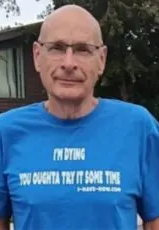
Let’s put words like these in our language and start feeling them and using them, and who knows where it will lead! I know where dementia leads, and as I’m on my way there, I want this approach to be available to me, so I invented I-Have-Now.com, which says that my life and my death are part of each other as the dementia advances. And for me expressing it, even on a T-shirt (see photo above), is part of feeling it.
I feel that a word that expresses what I’m going through is “release,” and that it’s important to me to explore this more. Actually, now that I realize that I’m on my way to the final exit, I feel that there is very much to explore here — I’ve been on the way since the moment I was born and didn’t realize it at all. We’re all here, and the world feels completely different when we realize that fact.
Let’s explore it together — I’ll tell you what I feel along the way on my journey, and I welcome your feelings as you are on yours.
Marc D Malamud
Transitioning Doula
The Quiet Gift of Sitting With Someone at the End of Life
the gift goes both ways.
Marc D Malamud
Transitioning Doula
Subcategories
Obituaries & Memorials
This space is devoted to tender remembrance—a place to share stories, blessings, and the everyday moments that made each life uniquely precious. Through these tributes, we honor each beloved soul’s transition, hold their spirit close, and gently accompany the hearts who continue on without them.