
Why “Simple Cremation” Often Complicates Grief

The phrase “simple cremation” is often offered as an act of kindness. It suggests relief during an overwhelming moment. Fewer decisions. Lower cost. Less emotional exposure. In a culture that is deeply uncomfortable with death, simplicity is framed as care.
But grief does not experience simplicity the way logistics do. In practice, when ritual is skipped entirely, grief often becomes harder to locate, harder to process, and harder to integrate. Instead of being held by a moment of acknowledgment, it lingers without structure.
For many families, “simple cremation” means there is no service, no gathering, no viewing, and no ceremony. The body is transferred, paperwork is completed, and ashes are returned. It is often positioned as emotionally neutral, something that allows people to move on or address the emotional side later.
Grief does not work that way. When there is no moment that marks the death as real, the loss often feels unfinished. Months later, people describe feeling disoriented, as though the death never fully landed. They may not be able to name what is missing, only that something feels unresolved.
Across cultures and throughout history, humans have marked death with ritual because it is functional, not symbolic. Ritual creates a threshold between before and after. It gives the mind and body a clear signal that something irreversible has occurred. When that threshold is missing, grief often remains abstract, making it harder to integrate into daily life.
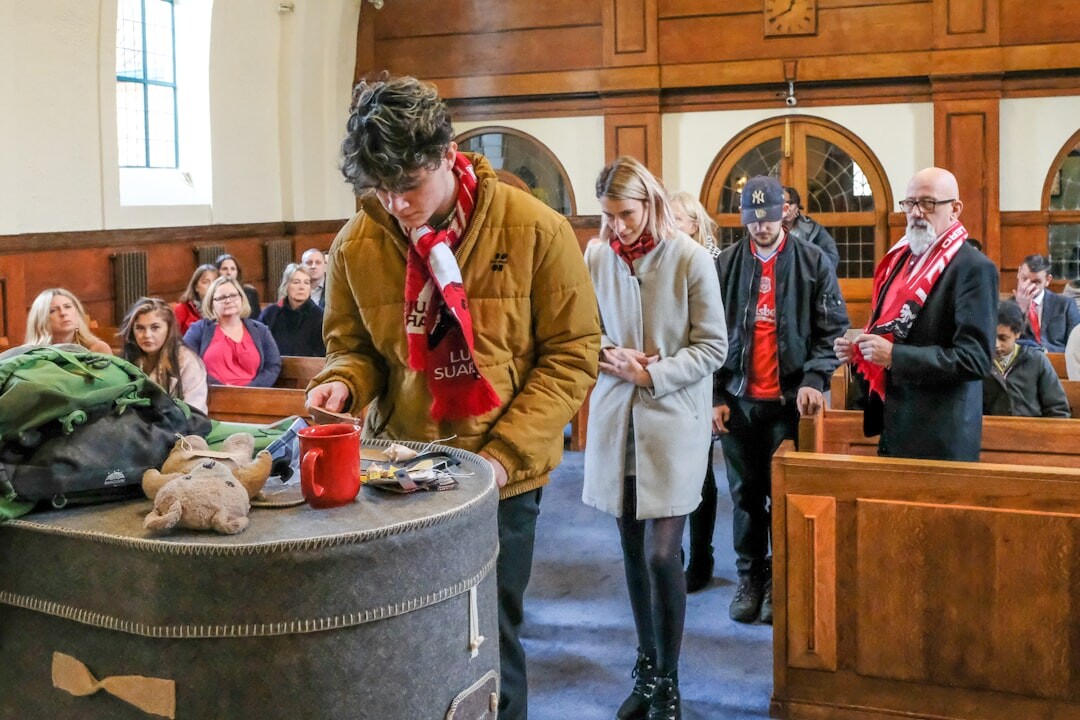
Photo by The Good Funeral Guide on Unsplash
Some families choose simple cremation because they believe they are protecting themselves from pain. They want to avoid seeing the body, crying in front of others, or feeling the weight of the moment. That instinct is understandable. Early grief is frightening. But avoidance does not remove pain. It only postpones it.
When grief has no container, it often appears later in less predictable ways. It shows up as exhaustion, anxiety, irritability, or sudden emotional overwhelm. By the time it surfaces, communal support has usually faded, leaving people to manage it alone. Ritual does not eliminate pain, but it gives grief a structure so it does not spill into every corner of life.
When death is handled quietly and privately, important elements are lost. There is no witnessing, which means no one sees the loss happen or stands alongside the bereaved. There is no shared language, making it harder to speak about what occurred or to tell stories out loud. There is also no anchor moment to return to later.
Grief is often treated as internal work, but it is also relational. People grieve more sustainably when their loss is acknowledged and seen. Silence can feel respectful, but it often deepens isolation.
Cost is a real concern, and it deserves to be named honestly. Many families are financially unprepared for death. However, there is another cost that is rarely discussed. When grief is left unsupported, people often pay later through prolonged distress, strained relationships, or the need for professional support. Emotional debt does not disappear because ritual was avoided.
Ritual does not require formality or expense. It does not require a chapel, a casket, or a large gathering. It requires intention. A deliberate moment in which the death is acknowledged and the life is honored. This can happen in a living room, a backyard, a forest, or around a kitchen table. What matters is that something happens.
Without any form of ceremony, cremated remains can feel especially heavy. Families often describe receiving ashes without context as unsettling. The remains feel more like a responsibility than a connection. Ritual provides meaning and helps transform ashes from an obligation into a symbol of relationship.
The word “simple” deserves closer examination. Simple does not mean absent. True simplicity preserves what is essential. After death, what is essential is not efficiency, but integration. Grief needs help becoming part of life again rather than lingering unresolved.
Instead of asking what the simplest option is, a more helpful question is what will help carry the loss. The answer will differ for every family, but almost no one benefits from acting as though nothing happened.
Needing ritual is not weakness. It is a human response to loss. Choosing something more than simple cremation does not mean choosing excess. It means choosing acknowledgment, structure, and support. Grief will arrive regardless. Ritual helps people meet it with steadiness and a place to stand.
Marc D Malamud
Transitioning Doula