
Grief Doesn’t Care About Your Calendar
When the World Keeps Going: Navigating Grief in a Workplace That Doesn’t Pause
Hey Friends,
When someone dies, the world doesn’t just stop for the person who’s grieving.
That’s one of the most disorienting parts of loss. Your world has completely halted — and yet, somehow, life keeps marching on. Inboxes still fill up. Deadlines still loom. Bills still need to be paid. People still expect responses, decisions, performance.
Meanwhile, you’re moving through a fog of grief… and you’re exhausted from answering the same question over and over:
“How are you doing?”
“I’m ok.”
But inside, the real answer is: “I am not well.”
You’re not ok. And frankly, it would be strange if you were.
What We Don’t See: The Hidden Work of Grief
From the outside, it might look like someone is “back to normal” after a loss because they’ve returned to work, are showing up on Zoom, or are posting on social media again.
Here’s what isn’t visible on the surface:
-
The hours spent on estate paperwork, insurance claims, and legal matters.
This isn’t a weekend project. Often, it’s 6–12 months of ongoing admin work: forms, phone calls, waiting on hold, tracking documents, following up on things you didn’t even know existed. -
The mental fog and decision fatigue.
Grief affects your brain. Concentration is harder. Memory slips. Even simple decisions — What should I eat? What email should I respond to first? — feel heavy. So imagine trying to produce your best work in that state. -
The emotional swings.
You might be fine one moment and then suddenly feel like you’re going to cry in the middle of a meeting because a word, a smell, or a comment triggered a memory. It’s not “being dramatic.” It’s grief doing what grief does.
I’ve had clients:
- Sitting in their work parking lot between meetings, trying to handle probate calls and funeral bills from their car.
- Quietly doing the bare minimum at work for months because they couldn’t concentrate, and silently panicking that everyone was noticing.
- Feeling ashamed that they “still weren’t over it” because their grief didn’t magically resolve after a few weeks of bereavement leave.
And I’ve been there, too.
My Own Reality of Grieving While Working
When I’ve lost important people in my life, there were days I simply could not function.
Back when I was working for someone else, there were mornings when I had to call in sick — not because I had the flu, but because I literally could not face a day of “normal” tasks while I was internally unraveling.
Later, as an entrepreneur, I had to do something that felt just as hard in a different way:
I canceled client sessions and networking meetings for weeks at a time.
I canceled client sessions and networking meetings for weeks at a time.
Not because I didn’t care about my work, or my clients. I deeply did. But my body and my nervous system were telling me the truth before my brain would admit it: I needed to shut down. I needed to rest. I needed to nap in the middle of the day. I was not operating at full capacity — and pretending otherwise would’ve only pushed me closer to burnout.
If you’ve ever tried to “power through” grief at work, you know exactly what I’m talking about. It’s not sustainable. And it’s not kind — to yourself or anyone else.
What Companies Often Miss About Grief
Here’s the thing: companies can’t take away grief — but they can either make it harder or make it more bearable.
Most workplaces aren’t intentionally unkind. They’re often just unprepared.
Many HR policies are built around the idea that grief is a short, contained event:
You get a few days of bereavement leave, you go to the funeral, then you come back and carry on.
You get a few days of bereavement leave, you go to the funeral, then you come back and carry on.
But grief doesn’t work like that.
A more realistic and humane approach acknowledges that grief is a long, uneven process, not a 3-day event. It includes:
-
Flexible schedules or work-from-home options.
So someone can attend appointments, handle estate-related errands, or just take a mid-day break when the emotional weight hits. -
Temporary workload adjustments.
Reducing nonessential projects, extending deadlines, or shifting high-pressure responsibilities for a period of time can make an enormous difference. -
Access to after-loss specialists (like me).
Someone who can help take the logistical burden — estate paperwork, notifications, coordination — off an employee’s plate, so they can focus on the emotional processing and basic functioning.
This isn’t just about being “nice.”
It’s about protecting people and productivity in a moment when pretending everything is normal is actually what causes the most harm.
It’s about protecting people and productivity in a moment when pretending everything is normal is actually what causes the most harm.
Grief Doesn’t Stay at Home When You Go to Work
One of the biggest myths I hear (often said silently rather than out loud) is:
“I should be able to leave my grief at home and be professional at work.”
But here’s the truth: You are one whole human being.
You don’t become a different person when you swipe your badge or log into your laptop.
You don’t become a different person when you swipe your badge or log into your laptop.
Grief shows up in:
- Your ability to concentrate
- Your motivation and energy
- Your patience and emotional capacity
- How you respond to stress and feedback
Expecting someone to separate their emotional reality from their work performance, especially after a major loss or during caregiving, is unrealistic and unfair.
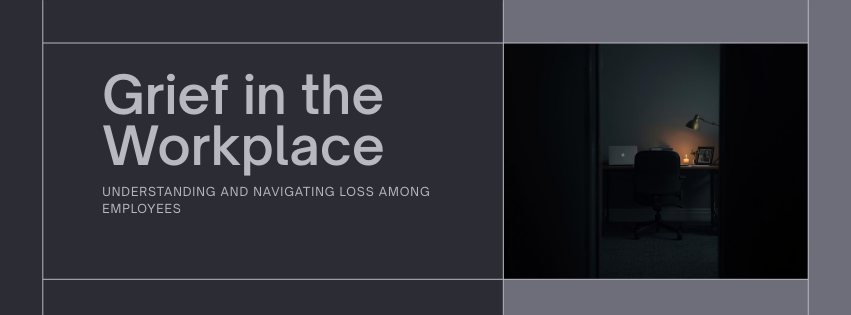
The Work I Do: Supporting Both Individuals and Organizations
My work sits in this intersection of grief, logistics, and work life.
I support individuals with:
- After-loss administrative tasks (paperwork, calls, coordination)
- Emotional support and grounding during those first disorienting months
- Practical planning so they don’t have to hold everything in their head while they’re grieving
And I also partner with organizations — especially HR and leadership teams — to provide:
- Workshops and trainings on grief, loss, and caregiving in the workplace
- Guidance on how to support team members going through a loss (or anticipating one)
- Education on why grief is not something you can just “leave at home” when you head into the office or log onto Zoom
The goal is simple and human:
To make space for people to be people — and to keep their careers, teams, and organizations intact in the process.
A Call to Leaders, Colleagues, and Anyone Who’s Grieving
If you’re an HR professional, manager, or leader, I invite you to ask:
- How do we currently support employees after a loss?
- Where are people falling through the cracks?
- What would it look like to build grief-informed policies and culture, not just bereavement days?
And if you’re someone grieving right now while trying to hold it together at work:
- You’re not weak.
- You’re not broken.
- You’re not “too much.”
You’re human.
You are doing an incredibly hard thing — functioning in a world that didn’t stop even though your world did.
You are doing an incredibly hard thing — functioning in a world that didn’t stop even though your world did.
You deserve support that recognizes that reality.
If this resonates with you — whether you’re navigating a loss yourself or you’re in a position to support others — I’d love to continue the conversation.
Let’s rethink how we handle grief at work, together. Let’s build workplaces where people don’t have to choose between their humanity and their career.
Marc D Malamud
Transitioning Doula